
Hey Friend,
I walk in and set my bags down on the kitchen table. It’s right inside the door from the garage, so it’s the most likely place for stuff to get piled. Why do we design homes this way? The mail, groceries, water bottles, keys, purse, school bags, and that paper that needs signed for school sports by tomorrow. It all needs cleared off the table before dinner. That’s the rule!
Looking closer at the table, I see the tiny dents and nicks in the wood and there’s a red stain from one of those stretchy hands you get from a “gumball machine” that got stuck to the table and left a stain years ago. I guess that can be covered by a placemat. And where did that black mark come from?
In our house, the kitchen is truly the heart of the home. It’s where the biggest messes happen and where some of our best conversations live.
When I was growing up, some of my favorite family moments happened around the kitchen table. I loved helping in the kitchen, and food was always central to our family gatherings. The meals mattered and time together mattered.
So when we started our own family, we decided early on that we would sit down together for dinner as often as we could and that was usually every day. That single decision has turned out to shape almost everything else. It’s a sacred time in our house.
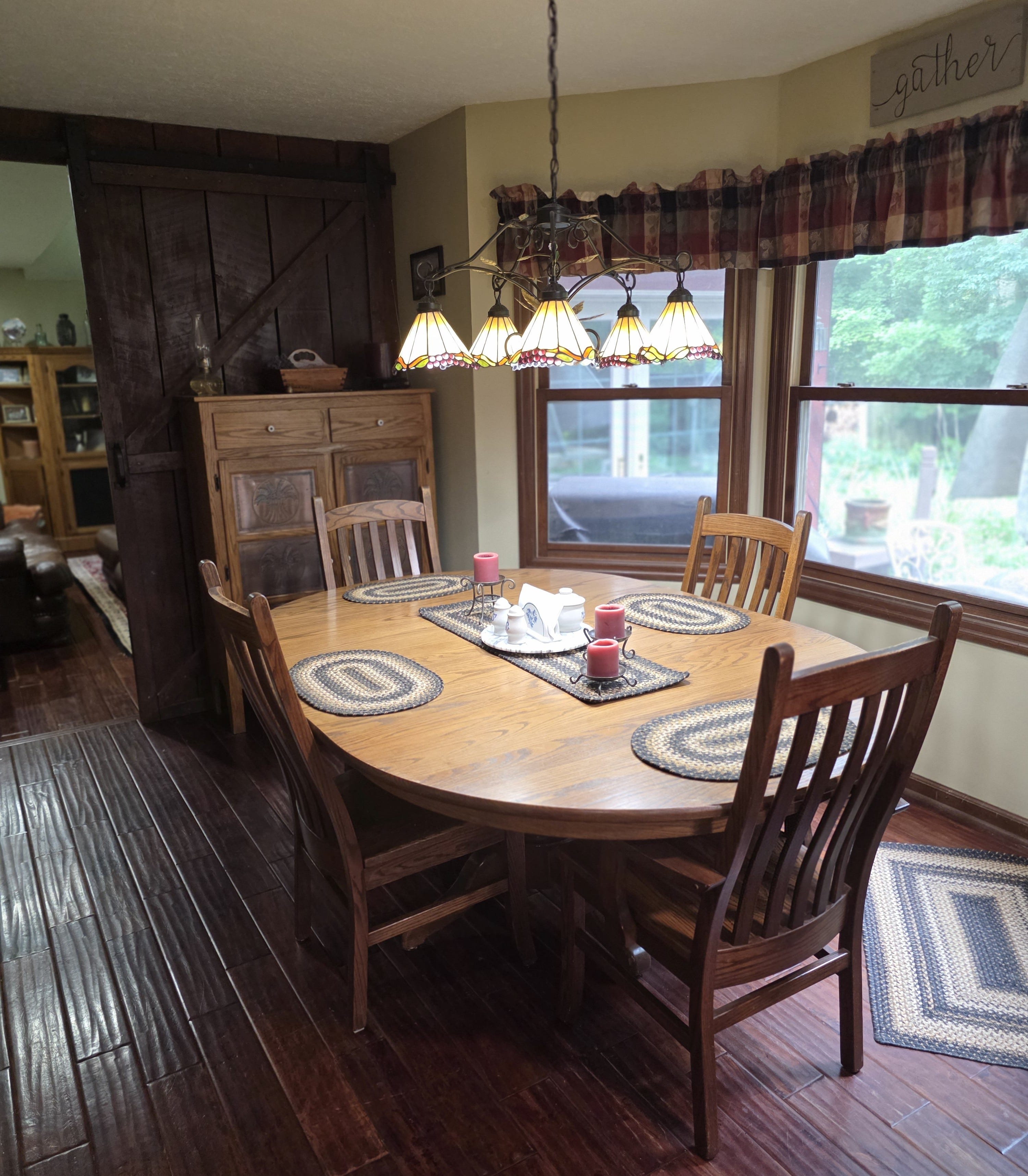
The table is where we’ve celebrate birthdays and graduations, wins and losses. It’s where we’ve played games, did schoolwork, shared stories, and had long talks. It’s where we’ve create a legacy of kids passing the same traditions on to their own families.
The kitchen table not only nourishes bodies, it forms people. Research has connected regular family meals around the table to stronger communication, better emotional regulation in kids, and a greater sense of belonging at home. But you don’t need a study to know that. If you sit at the table with your family you can watch it happen over time for yourself.
Our Rhythm, and How It has Changed
When the kids were little, we would set the table together and yes, the little ones can help with this, even if it’s not perfect. We would put the pans right on the table on hot pads and served our meals family-style. My in-laws used beautiful serving dishes, which I loved, but also... dishes. Too many dishes.
As the kids grew, we shifted to more of a buffet-style spread across the kitchen island. Everyone grabs a plate and utensils, gets their food, sits down, and waits until everyone else is seated before we eat. That waiting teaches patience.
As my kids have grown, mostly adults and married now, we cook together and share recipes they have adopted for their own families. Everyone pitches in a little with cooking and clean-up, whichever they prefer.
Etiquette - “Passing to the Right”
We had a well-loved copy of Emily Post’s 1922 etiquette book, that I inherited from my husband’s grandma, and we’d read through it with the kids on occasion and talk about table manners especially, because with two adults, six kids, and frequent friends at the table. A little order at the table went a long way.
One rule stated: Food passes counterclockwise, to the right, unless someone nearby asks for it directly. This kept dishes or condiments from colliding halfway around the table. We would also have a little fun with it. Once in a while, we’d pass the salt the “proper” long way around to someone sitting two or three seats to our left, just to make a fun point of it. This caused a lot of giggles and fun.
We would then choose another “proper etiquette” from the book and start over again. Like where to put your napkin while you are eating or which fork, spoon, or glass to use when there are multiples beside your plate. This taught our kids how to behave in public or at a friend’s house without taking ourselves too seriously.
Table Manners - “Blue Line Violations”
Our everyday plates have a blue line running around the rim. If food started sliding toward the edge, or worse, actually fell off and landed on the placemat, that was a “Blue Line Violation.” It was a light, funny way to let someone know they had a problem to take care of, without turning dinner into a lecture.
Saying Grace - “Youngest Child Spinner”
Before we eat, we always pray for one another and show gratitude for our meals. We have our own little game for deciding who prays at each mealtime.
The youngest child at the table, who’s old enough to understand the game, becomes the “spinner.” We pretend to spin a spinner in the air toward them, and they start twirling their little fingers like a game-spinner, going round and round until it “randomly” lands on someone at the table, sometimes even themselves. That person prays for us. It’s silly, it’s sweet, and sometimes we still play it with our grandkids.
Clean-Up - After dinner, we’d all clean up. Everyone has a job, even the youngest. Each evening we ran a simple “kitchen reset rotation”: counters and floors, unloading the dishwasher, loading the dishwasher, washing pans, and drying pans/putting them away. One person always had the evening off and trading tasks was allowed. It was quick.
Of course, there were arguments. There was also laughter and learning to get along. It was fun, at least I thought so and the kitchen was reset and ready for the next day.
A Little Note on Chores
There’s a well-known Harvard study on adult development that found one of the strongest predictors of success in young adulthood was something surprisingly ordinary: whether a child did chores growing up.
This idea makes sense. Children who do chores learn that effort leads to contribution, and contribution leads to belonging and that mindset that carries into relationships, careers, and the hard seasons of adult life.
Research suggests regular chores also support focus, planning, and impulse control in kids. So yes, give them chores.
The Game That Teaches Listening: The Spoon Game
If there’s one thing from our table I’d want every family to try, it’s this.
We call it the “Spoon Game.” It teaches conversation: how to ask a question, answer thoughtfully, and wait your turn without interrupting. It works just as well at restaurants while you’re waiting for food to arrive. Pick up any item from the table and start asking questions.
How to play:
• One item (a spoon works well) gets passed around the table.
• You cannot talk unless you’re holding the spoon.
• When you do have the spoon, you must talk and answer the question, even if you just say “pass.”
• Questions can be as simple as: What’s your favorite dessert? Movie? Animal? Cereal? Character? At a restaurant, it might be, “What’s your favorite menu item?” Be sure the question is an open-ended question, so you get more than a “yes” or “no” answer.
As my kids got older, we would ask questions that required more in-depth answers and ask their own questions for us.
Everyone gets a turn to speak, without interruption.
Creating Table Traditions
People remember traditions. Consider creating traditions that your family and guests look forward to.
Gratitude Bowl - Provide slips of paper where guests can write what they’re thankful for as they arrive. Read them together before dessert, without saying whose is whose. It turns into a quiet kind of guessing game. This is great for any time of the year, but it’s especially great for Thanksgiving or the whole month of November.
Family Story Night - Invite older family members to share stories from a specific era. Have them talk about their childhood, their first years of marriage, a hard season they made it through, recipes they have inherited. Record it if you can; you’ll want it again in ten years. This is one I wish I would have done more.
Recipe Exchange - For my kids that are now married and have a whole new spouse/family to get to know, ask them to bring a recipe (and maybe the dish) and the story behind it, who taught them, what occasion it belongs to. Copy the recipes onto cards before everyone leaves, so the story can travel home with others.
Hospitality: More Than a Meal
In our home, we’ve welcomed the neighbor kids, school and college friends, and exchange students from Japan and Germany who lived with us for months at a time. We’ve had a student from Brazil come for Thanksgiving who had never peeled a potato before. We gave her that experience and she appreciated it! She was so excited to learn a new skill. That was a different perspective for my kids to see.
Invite someone over. Teach your kids how to be hospitable.
Funny Story: We’ve hosted 3 different exchange students from Japan. They were told by the hosting organization to try to learn from and fit in with their host family by doing what they do.
For some reason, when my girls would take their socks off, they would leave them on their chair at the table so they could find them again later. I never noticed this habit until the first Japanese exchange student started doing this.
It’s fun to notice the quirky little habits our family had adopted over time.
Closing Reflection
Over the years, we’ve added and subtracted chairs and leaves from our table. High chairs and booster seats have entered the picture. None of this has ever been about having the perfect table. It was about showing up to the same table, night after night, imperfect, loud, occasionally chaotic and messy, and somehow exactly right.
I would love to hear some of the ways your family relates to one another around the dinner table. Tell me a story!
Warmly,
~ Nelle, Mama’s Homestead
Rooted. Gathered. Passed Down.
P.S. — If someone you love has been quietly longing for this kind of life, will you share this with her? Forward this email. Send her the link. Sometimes all a woman needs is for someone to say — there is a place for you here.
P.P.S. — Thank you for being here! We are just getting started. The best is ahead. Stay close.